info@gensolar.in
 +91 93987 35165


How Many Solar Panels Do You Need to Run Common Home Appliances?
Solar energy can help households reduce their dependence on grid electricity and generate power from a renewable source. However, one of the most common questions when planning a home solar system is how many solar panels are actually required to run everyday appliances.
The answer depends on several factors, including the appliance's power consumption, how long it is used each day, the wattage of the solar panels, available sunlight, and the overall system design.
1. Understand Appliance Power Consumption
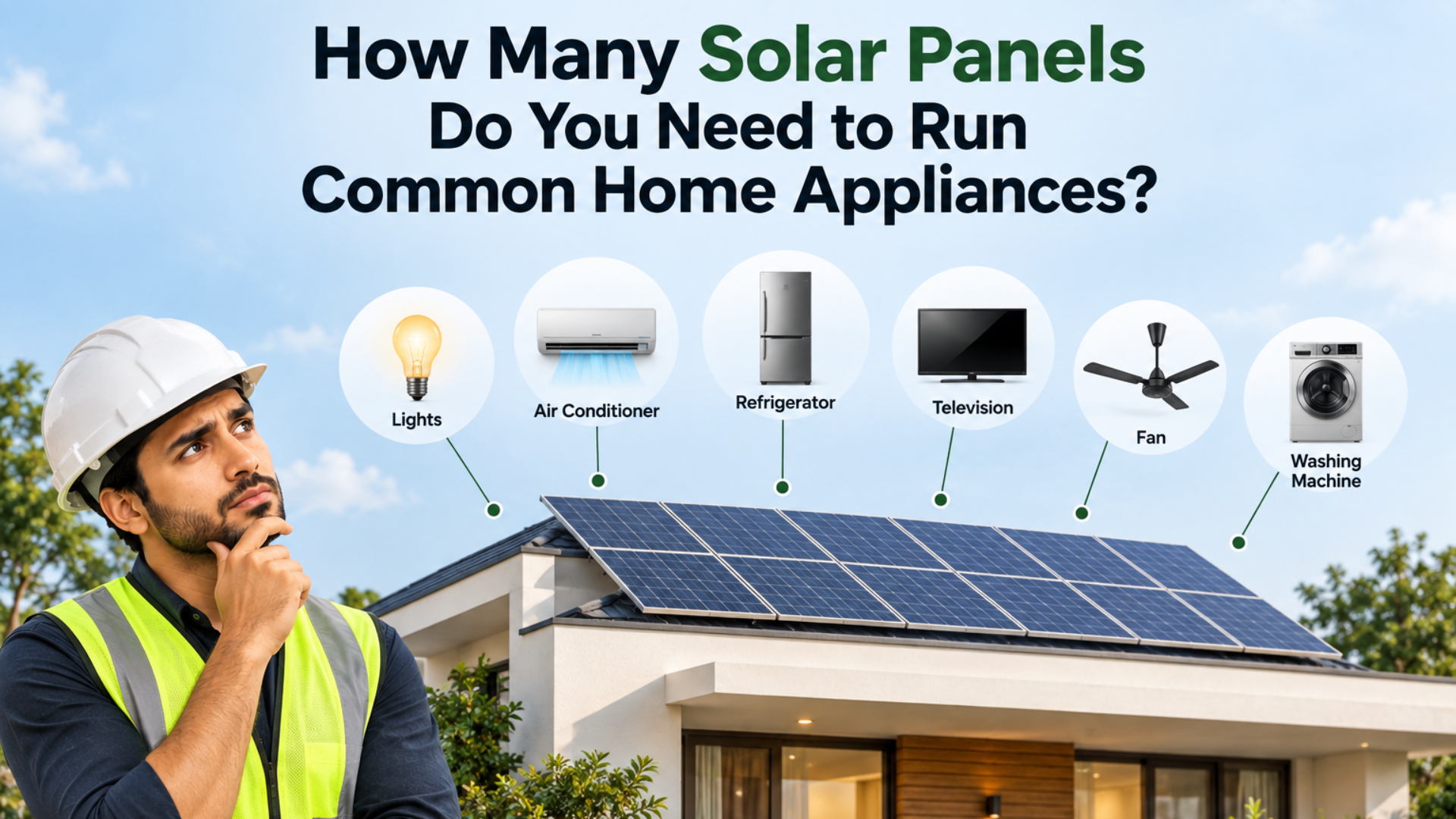
The first step is to identify how much electricity each appliance consumes. Appliances such as refrigerators, fans, televisions, washing machines, lights, air conditioners, and water pumps have different power requirements.
For example, a small appliance may consume only a few hundred watts, while an air conditioner or water heater can require significantly more power. Checking the appliance's rating label or manufacturer's specifications can help determine its approximate energy consumption.
2. Calculate Your Daily Energy Requirement
Solar systems are generally sized based on energy consumption rather than simply the number of appliances in a home.
To estimate daily consumption, multiply the appliance's power rating by the number of hours it operates each day.
Daily Energy Consumption = Appliance Power × Hours of Use
For example, a 100-watt appliance operating for 5 hours would consume approximately 500 watt-hours, or 0.5 kWh, per day.
Add the estimated consumption of all appliances to determine the household's approximate daily energy requirement.
3. Consider Solar Panel Capacity
Solar panels are available in different capacities, commonly ranging from a few hundred watts per panel for residential installations. The number of panels required depends on the panel's rated capacity and the amount of electricity the system is expected to generate.
For example, if a household requires a solar system with a capacity of around 3 kW and uses 500-watt panels, approximately six panels would provide 3 kW of installed panel capacity.
Actual energy generation will vary depending on sunlight, panel orientation, shading, temperature, system losses, and other conditions.
4. Account for Peak Sun Hours
Solar panels do not produce their rated output continuously throughout the day. Energy generation changes with sunlight intensity and weather conditions.
When planning a residential solar system, local solar conditions and expected peak sun hours should be considered. This helps provide a more realistic estimate of how much energy the panels can generate each day.
5. Think About High-Power Appliances
Some household appliances require considerably more energy than others. Air conditioners, electric water heaters, induction cooktops, washing machines, and water pumps can significantly increase household electricity consumption.
If these appliances are expected to operate regularly using solar power, the system may need additional panel capacity. Their starting or surge requirements should also be considered when selecting the inverter.
6. Do You Need a Battery?
A solar system can be designed with or without battery storage. If the goal is to use solar power during the evening or maintain electricity during a grid outage, batteries can store excess solar energy for later use.
Battery capacity should be selected according to the loads that need to operate and how long they need to run.
There is no single number of solar panels that will work for every home. The required quantity depends on daily electricity consumption, appliance usage, panel capacity, sunlight availability, inverter capacity, and battery requirements.
Start by calculating your household's daily energy needs and identifying the appliances you want to power. A qualified solar professional can then use this information, along with local site conditions, to design a suitable residential solar system.